

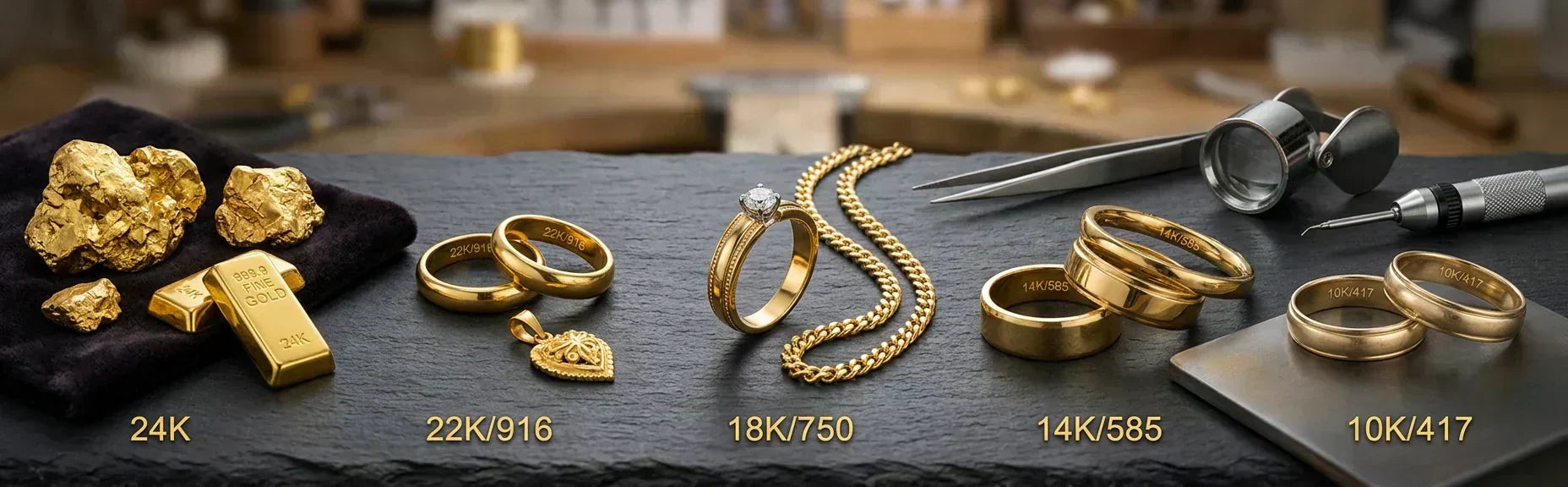
Understanding Gold Purity and Karat
When shopping for gold jewelry, you will invariably notice a small number followed by the letter "K" stamped into the metal, such as 24K, 18K, or 14K. While these markings are universal across the jewelry industry, many buyers remain uncertain about what they mean.
Choosing the right gold piece requires balancing visual beauty, structural durability, long-term wear, and your budget. Because gold is naturally soft and malleable, higher purity means more gold content but less resistance to scratching, bending, and everyday wear.
This comprehensive guide breaks down the karat system, explains how gold purity is officially measured, explores the role of alloy metals, and provides practical advice to help you select the ideal karat for your personal collection.
What Does "Karat" Mean?
A gold item's karat rating indicates its purity. The international grading system divides gold into 24 equal parts. If a piece of metal is described as 24-karat gold, it means all 24 parts are pure gold, free of other elements.
If a piece of jewelry is labeled 18-karat gold, it contains 18 parts pure gold and 6 parts of other alloy metals. Similarly, 14-karat gold consists of 14 parts pure gold and 10 parts of alloy metals. These additional metals, often silver, copper, zinc, palladium, or nickel, are deliberately added to the molten gold during manufacturing.
Pure gold, on its own, lacks the structural integrity to securely hold gemstones or maintain a complex shape under normal physical stress. Blending pure gold with stronger elements creates a material that resists denting, warping, and scratching.
Karat vs. Carat: It is easy to confuse these two terms because they sound identical, but they serve completely distinct purposes in gemology.
Karat (with a "K") measures the fractional purity of gold. The most common abbreviation is K, though you will also frequently see Kt.
Carat (with a "C") is a unit of mass used exclusively to measure the weight of diamonds and other gemstones, where 1 carat equals exactly 200 milligrams. The universal abbreviation is ct. If you are referring to the total weight of multiple gemstones in a single piece of jewelry, it is abbreviated as ctw (Carat Total Weight).
How Gold Purity Is Measured and Labeled
The global jewelry market relies on two parallel systems to express gold content: the traditional Karat System and the modern Fineness System (also known as millesimal fineness). The table below outlines how these two systems correspond to the most common commercial gold purities.
The Gold Purity Conversion Scale
|
Karat Rating |
Pure Gold Percentage |
Millesimal Fineness Mark |
Parts of Pure Gold (Out of 24) |
|
24K |
99.9% |
999 |
24 / 24 |
|
22K |
91.7% |
916 |
22 / 24 |
|
18K |
75.0% |
750 |
18 / 24 |
|
14K |
58.3% |
585 |
14 / 24 |
|
10K |
41.7% |
417 |
10 / 24 |
As seen in the visual comparison above, the proportion of alloy metals directly influences the final color of yellow gold. Higher-karat options exhibit a noticeably deeper, warmer tone, while lower-karat selections offer a more muted, subtle yellow because of the higher concentration of silver or zinc in the matrix.
Deciphering the Hallmark
Authentic gold jewelry bears a small stamp called a hallmark, typically found on the inner band of a ring, the back of a pendant, or near the clasp of a necklace or bracelet. This hallmark serves as an official certification of the metal's gold content.
Depending on where the jewelry was manufactured, the stamp may show the traditional karat format (such as "14K" or "18Kt") or the millesimal fineness number (such as "585" or "750").
These stamps guarantee the precious metal content but do not directly indicate the grade of craftsmanship or artistic value. A beautifully hand-engraved 14K ring requires highly skilled labor and may command a higher retail price than a simple, machine-stamped 18K band of equal weight. Purity measures composition, not design quality.
Why Jewelry Is Rarely Crafted from 24K Gold
When shopping for something special, you might think, "Why not buy 24K gold? It's the purest, so it must be top-quality." It's understandable to link total purity with luxury. However, pure gold isn't practical for everyday wear. It's natural qualities that make gold unique. Its softness and malleability also make it unsuitable for jewelry. In its pure, 100% form, gold is extremely soft, resembling warm wax compared to other metals. While this softness is beneficial in industrial applications, such as creating thin gold leaf sheets, it's a disadvantage in jewelry. Consider the daily wear and tear your hands endure: opening heavy doors, carrying groceries, typing, or lifting weights. Wearing a solid 24K gold ring through all that would likely result in significant damage quickly.
Here is what actually happens to pure gold in the real world:
It Warps Out of Shape: Because the metal is so pliable, a perfectly round ring band won't stay round for long. Under the minor pressure of your everyday grip, it will gradually warp into an awkward, uncomfortable oval.
The Details Disappear: If your jewelry has beautiful, intricate details, such as sharp geometric facets, delicate textured borders, or custom engravings, they will quickly flatten. The constant friction of brushing against your clothes, pockets, and skin acts like sandpaper, smoothing away the design.
You Risk Losing Your Gemstones: This is the biggest deal-breaker. Gemstones are held in place by tiny metal claws called prongs. If those prongs are made of 24K gold, they are too weak to stay clamped shut. A single accidental knock against a kitchen countertop or a car door could easily bend a prong outward, causing your diamond or gemstone to fall out and vanish.
Because it is so delicate, you will rarely find 24K gold in a standard jewelry store. Instead, its softness means it is usually reserved for investment gold bars, collectible coins, or traditional ceremonial jewelry that is worn only a few times a year and stored safely in a velvet box the rest of the time.
To make gold tough enough to withstand the rigors of the modern world, jewelers have to alloy it with stronger metals. This blending process, known as alloying, is what gives us the durable, beautiful jewelry we can actually wear with confidence every day.

Visual comparison of gold color richness across 14K, 18K, 22K, and 24K purities.
A Detailed Breakdown of Common Gold Karats
To find the right balance for your jewelry collection, it helps to analyze each common karat grade individually, closely examining its composition, physical properties, and aesthetic attributes.
24-Karat Gold (99.9% Pure Gold)
- Composition: 24 parts gold, 0 parts alloy metals.
- Visual Profile: A highly distinct, intense orange-yellow color that no blended alloy can replicate.
- Physical Traits: Extremely heavy by volume due to the high density of pure gold, yet highly susceptible to structural distortion and deep surface scratches.
- Best Suited For: Long-term wealth storage, financial investment portfolios, high-end collectible medallions, and delicate decorative gold leafing.
22-Karat Gold (91.7% Pure Gold)
- Composition: 22 parts gold, 2 parts alloy metals.
- Visual Profile: Retains nearly all the saturated, rich yellow warmth of 24K gold, with only a slightly brighter tint from the minor alloy additions.
- Physical Traits: Slightly tougher than pure gold, yet still exceptionally soft compared to standard commercial jewelry metals. It requires deliberate care and protection from impact.
- Best Suited For: High-value ceremonial bridal sets, traditional dowry jewelry, or simple, thick statement earrings and necklaces that rest flat against the skin without experiencing high friction.
18-Karat Gold (75.0% Pure Gold)
- Composition: 18 parts gold, 6 parts alloy metals.
- Visual Profile: Offers a luxurious, bright golden hue that immediately signals premium quality without appearing overly orange.
- Physical Traits: The traditional benchmark where luxury meets real-world utility. The 25% alloy addition creates a strong crystal matrix that holds its shape well and resists everyday scratches, while the high concentration of pure gold preserves excellent resistance to tarnishing or chemical oxidation.
- Best Suited For: Luxury engagement rings, high-end bridal jewelry, custom designer pieces, and fine gemstone mountings meant to last for generations.
14-Karat Gold (58.3% Pure Gold)
- Composition: 14 parts gold, 10 parts alloy metals.
- Visual Profile: A beautiful, slightly more subdued classic yellow gold appearance that complements a wide array of skin tones.
- Physical Traits: Highly durable, resilient, and structurally stable. With more than 40% of its volume composed of reinforcing alloys such as copper and silver, 14K gold offers excellent protection against daily impacts, scratches, and bending. It holds fine detail exceptionally well over decades of continuous wear.
- Best Suited For: Daily-wear jewelry, wedding bands, active lifestyle rings, tennis bracelets, everyday earrings, and fine commercial jewelry collections.
10-Karat Gold (41.7% Pure Gold)
- Composition: 10 parts gold, 14 parts alloy metals.
- Visual Profile: A lighter, paler yellow tone due to the dominant presence of base metals in the alloy blend.
- Physical Traits: Exceptionally hard and rigid. Because it contains more alloy metals than pure gold, it is highly resistant to scratching, scuffing, and warping. However, due to the higher base-metal content, it may feel slightly lighter on the wrist or finger than an identical piece made of denser 18K or 24K gold.
- Best Suited For: Budget-conscious shoppers, heavy-duty industrial jewelry, graduation class rings, sports championship rings, and utility jewelry designed to withstand rugged daily wear.
The Interplay of Durability, Weight, and Value
When choosing a karat, it helps to understand that you are navigating an inverse relationship between purity and physical resilience. As the percentage of pure gold decreases, the metal's hardness typically increases.
Higher Purity / 24K
Richer, deeper yellow color
Higher raw material cost
Softer, easier to scratch
Higher density (feels heavier)
Lower Purity / 10K
Paler, softer yellow color
More affordable price point
Harder, highly scratch-resistant
Lower density (feels lighter)
Beyond hardness, alloy choices also affect a piece's overall weight and feel. Pure gold is one of the densest elements on Earth, with a specific gravity far exceeding that of copper, zinc, or nickel. Consequently, an 18K ring will feel noticeably heavier and more substantial on your hand than an identical 14K ring. For many collectors, this weight is a key part of the tactile luxury of high-karat jewelry.
How Your Selection Changes by Jewelry Type
Because different types of jewelry experience vastly different levels of physical contact during the day, the ideal karat rating often depends heavily on the specific item you are purchasing.
Rings and Wedding Bands
Rings are the most vulnerable pieces of jewelry. Every time you grip a steering wheel, turn a metal door handle, carry keys, or rest your hands on a stone countertop, your ring collides with hard surfaces.
Recommendation: For an engagement ring or wedding band intended to be worn continuously for decades, 14K gold is often the ideal choice. It offers the structural strength needed to keep diamond prongs secure while remaining highly scratch-resistant.
Alternative: If you prefer the prestige and deeper tone of 18K gold, it is perfectly suitable for daily wear, but you should expect it to accumulate a fine network of superficial scuffs (known as a patina) slightly faster, requiring occasional professional polishing.
Bracelets and Bangles
Like rings, bracelets are prone to high-impact wear. Your wrist constantly brushes against desks while typing, knocks into door frames, or rubs against fabrics and hard surfaces.
Recommendation: Solid bangles and heavy chain links perform exceptionally well in 14K or 10K gold. Lower karats prevent individual links from stretching or distorting under tension, ensuring the clasp remains secure over long periods of wear.
Necklaces and Pendants
Necklaces spend their lives resting safely against your skin or clothing, far from the high-impact hazards your hands and wrists face.
Recommendation: Because necklaces experience minimal physical impact, you can confidently opt for higher purities like 18K or 22K gold. This lets you fully enjoy the rich, warm color of premium gold right at your neckline without worrying about structural damage.
Earrings
Like necklaces, earrings are worn in a highly protected zone. Aside from occasional contact with hairbrushes, phones, or clothing, they face almost no environmental abrasion.
Recommendation: Earrings are an excellent place to choose 18K or 22K gold if you want maximum color vibrancy. Furthermore, since the earlobe can be sensitive to base metals, the higher gold purity of 18K reduces the likelihood of skin irritation or allergic reactions to trace metals like nickel.
Global and Cultural Perspectives on Gold
Gold buying habits are deeply intertwined with cultural history, resulting in distinct preferences around the world.
North America: The jewelry markets in the United States and Canada are heavily focused on practical durability and affordability for everyday wear. As a result, 14K yellow and white gold holds a dominant market share, while 10K is widely used for entry-level fashion jewelry and 18K is reserved for luxury boutiques.
Europe: Many European countries, particularly Italy, France, and the United Kingdom, have historical standards favoring higher minimum purities. In these markets, 18K gold is widely considered the standard for fine jewelry, and in some countries, metals below 14K or 9K cannot legally be marketed as "real gold."
Asia and the Middle East: Throughout India, China, and much of the Middle East, gold is viewed as both wearable art and a primary vehicle for long-term family wealth and financial security. Jewelry is often bought based on the daily spot price of pure gold, plus a small manufacturing fee. Consequently, 22K and 24K gold are the cultural standards for weddings, festivals, and traditional family heirlooms, while lower-karat options are far less common.

Practical Buying Advice for Your Next Purchase
When choosing a piece of gold jewelry, use this step-by-step checklist to find the right karat for your needs:
Evaluate Your Lifestyle: Do you work with your hands, garden, or maintain an active fitness routine? If you plan to wear the piece 24/7, stick with the durability of 14K gold. If the item is for office wear, formal dinners, or weekend galas, you can safely choose 18K or 22K.
Verify the Metal Allergy Profile: If you have sensitive skin or a known nickel allergy, higher-purity gold is always the safer choice. 18K gold contains far fewer trace alloys than 14K or 10K, greatly reducing the risk of contact dermatitis or skin discoloration.
Inspect the Hallmarks Personally: Before finalizing any transaction, ask your jeweler for a loupe and check the piece for a proper hallmark (such as 585 for 14K or 750 for 18K). This verification step ensures you are paying for the exact gold content advertised.
Work with Trusted Professionals: Fine jewelry is an emotional and financial investment. Always purchase from a reputable jeweler who provides transparent documentation, clear return policies, and standalone appraisal certifications for high-value items.
Ultimately, there is no single, objectively "best" karat choice. Instead, the right choice is the one that best matches your daily lifestyle, fits your budget, and gives you complete confidence every time you wear it.
Key Takeaways
This quick summary condenses the essential concepts of gold karats, structural durability, and visual characteristics. Use these takeaways as a reference to help you balance luxury, everyday durability, and budget for your next jewelry purchase.
- Purity Definition: Karat measures the proportion of pure gold out of 24 parts. 24K is pure gold, while 14K contains 14 parts gold and 10 parts alloy.
- The Role of Alloys: Base metals such as silver, copper, and zinc are added to pure gold to enhance hardness, structural durability, and wear resistance.
- Dual Labeling: Purity can be stamped as a traditional karat number (14K) or a three-digit millesimal fineness number (585), which represents the percentage of gold content.
- Color Dynamics: Higher-karat gold has a deeper, richer yellow hue. Lower-karat options exhibit a brighter, softer yellow tone due to the presence of secondary metals.
- The Durability Trade-Off: Higher-karat gold is more valuable and prestigious, but it is softer and more prone to everyday scratches and bending.
- Contextual Selection: High-impact items like daily rings and bracelets are best suited to 14K or 10K gold, while low-impact items like earrings and necklaces can easily use 18K or 22K gold.
Frequently Asked Questions (FAQs)
1. What is the difference between "karat" and "carat"?
Though they sound identical, they measure different things in jewelry. Karat (with a "K") refers to the fractional purity of gold on a 24-part scale. Carat (with a "C") is a unit of weight used exclusively for diamonds and gemstones, where 1 carat equals exactly 200 milligrams.
2. Why isn’t daily jewelry made from pure 24K gold?
Pure 24K gold is exceptionally soft and malleable, making it impractical for daily wear. Without reinforcing alloy metals, a 24K gold ring will easily warp out of its circular shape. Intricate engravings will quickly smooth away, and structural prongs will be too weak to securely hold gemstones in place.
3. What do the three-digit numbers like "585" or "750" stamped on my jewelry mean?
These numbers represent the millesimal fineness system, which describes gold purity as a percentage out of 1,000 parts rather than 24 parts. For example, a "585" stamp means the piece is 58.3% pure gold (equivalent to 14K), while a "750" stamp means it is 75% pure gold (equivalent to 18K).
4. Does lower-karat gold mean inferior quality?
Not at all. A lower karat rating simply indicates a different metal composition engineered for a specific purpose. While a 14K or 10K piece contains less raw gold by volume than an 18K piece, it offers significantly greater hardness and scratch resistance, making it structurally superior for high-impact jewelry like wedding bands or daily bracelets.
5. Why does 18K gold feel heavier than 14K gold?
Pure gold is one of the densest, heaviest elements on Earth. Because an 18K piece contains a much higher concentration of pure gold (75%) than a 14K piece (58.3%), it will have a noticeably heavier, more substantial feel on your hand or wrist than an identically sized lower-karat piece.
6. Which karat gold is best if I have sensitive skin or metal allergies?
If you are prone to skin irritation or have a known nickel allergy, 18K gold or higher is your best option. Because higher-karat gold features a much greater percentage of pure gold and far fewer trace base-metal alloys, it is significantly less likely to cause contact dermatitis or leave dark discolorations on your skin.
Yellow, white, and rose gold may all start with the same genuine gold, but their final appearance, chemical composition, and everyday performance differ significantly. In our next article, Gold Colors Explained, we will dive deep into how these color profiles are created, examine how different metal blends affect durability, and help you choose the perfect gold shade to match your unique skin tone and personal style.